Doximity - Medical Network
- 4.8
- Rating
- 500.00K
- Installs
- Free
- Price

 Analysis by App-foxy
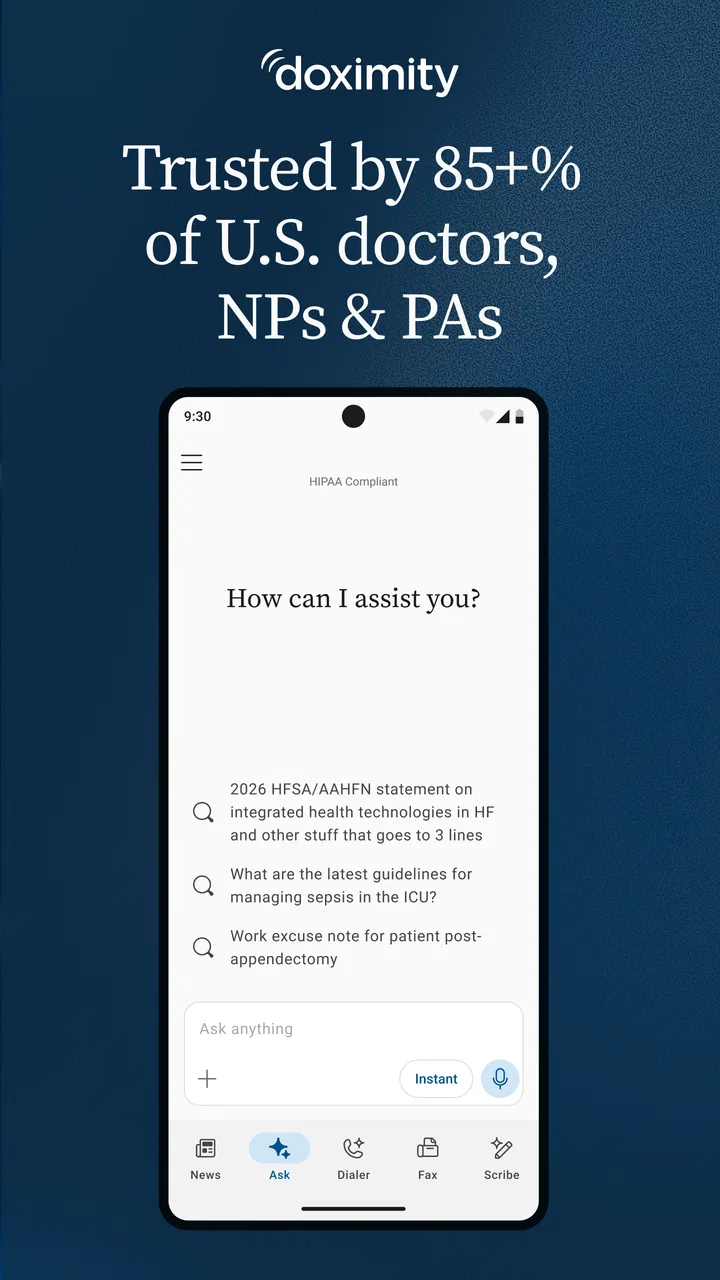
Doximity is a medical networking app that I found most useful when professional communication needs to happen quickly from a phone. It is made by Doximity, Inc., is free to use, and is aimed at healthcare professionals rather than patients looking for general medical advice. The central experience is simple: keeping a professional network within reach and making it easier to connect while moving between clinics, hospitals, offices, and home.
That focus makes the app feel different from a general social network. I would not install it expecting broad public conversation, entertainment, or a replacement for a hospital’s clinical systems. I see it more as a mobile layer for professional contact. Its medical category, Everyone age rating, and long presence on mobile stores make it approachable, but the value still depends heavily on whether the people and professional context I need are represented there.
How the professional network feels in everyday use
In a realistic workday, the strongest use case is the short moment between responsibilities. I might leave a consultation, need to reach a colleague, and prefer not to search through several unrelated personal communication apps. A dedicated medical network gives that interaction a clearer professional setting. The benefit is not just having another contact list; it is having a place where the reason for connecting is more likely to be work-related.
You May Also Like

 Blood Strike: 2.5 Anniversary
Blood Strike’s Loadouts Turn Every Drop Into a Tactical Gamble
A close look at Blood Strike’s custom loadouts: how fast access to signature weapons reshapes its battle royale rhythm, rewards preparation, and narrows the gap between fights.

 Pandora - Music & Podcasts
Pandora’s Music Is Easy to Start, but Harder to Recover
Pandora’s strength is its low-effort path from a seed to a station. Its weak spot is how much confidence it asks you to place in connection, setup, and quiet recovery.

 8 Ball Pool
 Is Built on Rivalries, Rematches, and Routine
A close look at the rivalries, rematches, shared routines, and unanswered safety questions that turn a quick pool match into a persistent mobile community.

 Samsung Music
’s Quiet Strength Is Playing What You Already Own
Its reach comes less from spectacle than from dependable access to a personal library. That simplicity is both the app’s strongest retention engine and its ceiling.

 AccuWeather: Weather Radar
AccuWeather Review: A Quick, Clear Forecast for Everyday Decisions
For everyday plans, the best forecast is the one you can understand quickly. AccuWeather makes rain timing, radar, and local conditions easy to act on, with a few trade-offs.

 Hill Climb Racing
Why Hill Climb Racing Still Turns Crashes Into One More Run
A tiny car, a bumpy hill and one more upgrade: Hill Climb Racing keeps resurfacing because its simple chaos makes every near-miss feel personal.
More From Our News Desk



That distinction matters for clinicians who regularly move between departments or institutions. A general messaging app can be convenient, but it mixes family, friends, shopping alerts, and work conversations. Doximity is more focused, so I found the idea of opening it with a specific professional task in mind more practical than treating it as a social feed I need to monitor constantly.
The app’s average rating is 4.8 from around 7,600 ratings, with roughly 2,800 written reviews. Those figures suggest that many users find the basic experience worthwhile, although a strong rating should not be mistaken for a guarantee that it fits every specialty, workplace, or communication policy. A networking app becomes useful only when it supports the contacts and habits I actually have.
Where connectivity becomes the real feature
The most important limitation is also the easiest to overlook: this is a connected service. Browsing professional information, reaching contacts, or carrying out other network-based actions depends on a functioning internet connection and on the service responding normally. In a hospital with unreliable reception, a crowded public network, or a basement area with weak coverage, the experience can become less dependable exactly when I am in a hurry.
I would therefore treat Doximity as a convenient communication option, not as the only route to an important professional contact. For urgent clinical matters, the correct fallback may be a hospital-approved system, a direct phone procedure, or an established internal channel. The app can sit alongside those methods, but it should not replace the workflow required by an employer or healthcare institution.
There is a useful habit here: before relying on the app during a busy shift, I would identify which contacts are genuinely important and make sure I know the alternative way to reach them. That small preparation changes the app from a hopeful convenience into one part of a reliable communication plan.
Using it while moving between work settings
Mobile access is where the app makes the most sense. Healthcare professionals rarely spend an entire day at one desk, and a phone-based network can be more practical than waiting to return to a computer. I can imagine using it during a corridor transition, between appointments, or while traveling between locations, provided that the action is appropriate for the setting and does not distract from patient care.
That convenience comes with a trade-off. A phone screen encourages quick interactions, but professional communication sometimes needs careful checking. Small screens make it easier to select the wrong person, skim a detail too quickly, or send a message before considering whether the channel is suitable. My advice is to use the app for clearly defined contact tasks and pause before sending anything sensitive, urgent, or easy to misunderstand.
The strongest mobile workflow is therefore selective. I would use it to locate or reach a professional contact when the situation allows, then move to the organization’s approved process when the conversation involves records, formal documentation, or clinical decisions that require a controlled system. This keeps the convenience of mobile networking without confusing it with a complete healthcare platform.
Another practical point is attention. A professional network can still create interruptions. If notifications or incoming activity pull focus during consultations, procedures, or rounds, the app becomes a distraction rather than an aid. I would review notification behavior early and develop a routine for checking the service at suitable times instead of reacting to every alert immediately.
What happens when the connection or workflow fails
Failure in a connectivity-dependent app is not always dramatic. Sometimes a page takes longer to load, a search does not return what I expect, or a contact action feels uncertain because the network changes while I am using it. In those moments, the worst response is repeated tapping. That can create duplicate actions or leave me unsure whether something actually went through.
My preferred recovery approach is simple: stop, check the connection, wait briefly, and confirm the result before trying again. If the action remains unavailable, I would switch to the approved backup method rather than spending several minutes troubleshooting during a time-sensitive task. This is especially important in medical environments, where the cost of delay can be higher than the inconvenience of using another channel.
I also would not assume that a successful connection means the recipient has seen or acted on something. Networking and communication are not the same as acknowledgement. For a non-urgent professional request, that may be fine. For a matter that needs confirmation, I would use a method that clearly fits the urgency and the responsibilities involved.
The app’s current version is 11.70.0, and it requires at least operating system version 10. That makes compatibility a practical consideration for anyone using an older phone or an organization-managed device. Before planning a rollout across a team, I would check the phones in use rather than assuming every device can install the latest version. A single incompatible device can undermine a shared workflow.
Privacy-minded habits for a medical networking app
Because the app is designed for healthcare professionals, I would approach every interaction with more caution than I would use on an ordinary social platform. The store summary describes it as convenient and secure, but convenience and security do not remove the need for good judgment. I would avoid treating a professional network as a place to casually paste patient-identifying information or detailed clinical material.
A useful rule is to separate networking from documentation. Finding a colleague or starting a professional conversation is one task; recording patient information, making a formal clinical note, or sharing material governed by workplace policy is another. The latter should stay in the system approved for that purpose. This separation is one of the most important ways to prevent a convenient mobile tool from being used beyond its proper role.
I would also keep the phone itself in mind. A networked medical app is being used on a personal or work device that may be viewed by other people, misplaced, or shared in a hurried environment. Screen privacy, device security, and careful notification handling matter just as much as the app’s own design. I would avoid displaying professional conversations where patients or visitors could read them.
For data-conscious use, the best approach is not to avoid the app entirely but to minimize unnecessary exposure. Use the smallest amount of information needed to identify the professional purpose, confirm that the recipient is correct, and move sensitive work into the designated channel. That workflow gives the app a clear boundary and makes its convenience easier to defend.
Who will get the most from it
I think Doximity is a good fit for healthcare professionals who need a focused way to maintain work-related connections from a mobile device. It is particularly appealing to people who switch locations, collaborate across professional circles, or dislike mixing work contacts with personal messaging. The fact that it has more than 500,000 installs shows that it has reached a substantial audience, but the more meaningful question is whether my own colleagues use it.
That network effect is crucial. If the people I need are active there, the app can save time and reduce the friction of finding the right professional connection. If they are not, the interface may feel polished yet provide little practical benefit. I would ask a few regular collaborators whether they use it before building an important workflow around it.
The free price also lowers the barrier to trying it. I can explore whether it fits my professional routine without treating the decision as a major purchase. Still, free does not mean cost-free in a broader sense: learning another communication channel, checking another inbox, and maintaining another professional profile all require attention. For a small practice with limited administrative time, that overhead may matter.
Who should choose another option
I would not recommend it as the main tool for someone who wants patient education, symptom checking, appointment booking, or a personal medical record. Its identity is professional networking, so those expectations point toward a patient-facing health app, a provider portal, or a formal clinical system instead.
It may also be the wrong choice for a team that already has a tightly controlled communication platform and does not want staff splitting conversations across multiple services. Fragmentation can create uncertainty about where a message belongs. In that situation, the existing approved system may be less convenient on a phone but more consistent for accountability and handoff.
Someone with an older device should also check compatibility before becoming invested. The minimum operating system requirement is version 10, and managed work phones can have restrictions that personal devices do not. If installation or updates are difficult, a browser-based or institution-provided alternative may be more practical, depending on the organization’s setup.
How it compares with familiar alternatives
Compared with ordinary phone calls, Doximity offers a more professional setting and can make a work contact feel less mixed with personal life. A call remains better when the issue is urgent, when a quick back-and-forth is needed, or when connectivity inside the app is uncertain. I would see the app as a useful complement rather than a universal replacement for calling.
Compared with general messaging services, its medical focus is the main distinction. General apps may have broader adoption among friends and coworkers, but they also bring more noise and may not match workplace expectations. Doximity is more specialized, which can improve relevance while narrowing its usefulness to professional healthcare communication.
Compared with an electronic health record or hospital collaboration system, it is likely to feel lighter and more mobile for networking. The trade-off is that a dedicated clinical platform is normally the better place for formal records, structured handoffs, and organization-specific oversight. I would not judge Doximity negatively for lacking that role; I would judge it by whether it helps with the narrower job of professional connection.
That comparison leads to a practical decision. If my problem is “How do I reach or stay connected with the right healthcare professional while away from a desk?”, this app is worth trying. If my problem is “Where should the official clinical work be recorded?”, I would choose the approved clinical system instead.
Small habits that make the experience more dependable
First, I would test the app in the places where I actually work rather than assuming a strong home connection represents the whole day. A service that feels immediate in one location may be slower in a crowded facility or while traveling. Knowing those weak spots helps me decide when to start an interaction and when to use a backup.
Second, I would keep requests concise and identify the professional purpose early. Mobile communication is easier to process when the recipient can understand why I am contacting them without reconstructing a long thread. This is not about making the app do more; it is about adapting the workflow to a small screen and an interrupted workday.
Third, I would establish a personal rule for sensitive information before using the app regularly. If I have to decide in the middle of a stressful situation whether a detail belongs there, the rule is too late. Separating networking from clinical documentation in advance reduces hesitation and protects against careless oversharing.
Finally, I would review whether the app is genuinely reducing friction after a few weeks. If I still reach everyone through phone calls or an institutional platform, maintaining another network may not be worthwhile. The right measure is not how many features I can find, but whether the app makes professional contact clearer, faster, or more manageable in my actual routine.
My connectivity verdict
After looking at the app through the realities of mobile healthcare work, I see Doximity as a focused professional network with a clear strength: it puts healthcare connections into a dedicated mobile context. Its free access, broad installation base, and strong average rating make it easy to consider, while the developer’s long-running presence in this category gives the product a sense of continuity.
My recommendation comes with boundaries. I would use it when I need professional networking on the move, but I would not depend on it as the sole route for urgent contact, formal clinical documentation, or sensitive patient information. Connectivity can fail, colleagues may not be active on the service, and a phone-based workflow can encourage rushed decisions. Those are not minor details; they determine whether the app helps or complicates a working day.
For a healthcare professional whose colleagues are already part of the network, I think it is worth trying. For a patient, a team with strict single-platform rules, or anyone seeking a complete clinical communication system, another option will probably be better. My final view is that Doximity works best when I give it one well-defined job: helping me stay connected to the professional medical community while remembering that reliable care still depends on appropriate channels, careful judgment, and a backup when the connection does not cooperate.
FAQs for Doximity - Medical Network
01What is Doximity and who is it intended for?
Doximity is a professional network specifically designed for healthcare professionals. It serves as a platform for doctors, nurses, and other medical staff to connect, collaborate, and share valuable insights. With features such as secure messaging, telehealth capabilities, and a comprehensive medical directory, it's an essential tool for those in the medical field.
02How secure is the Doximity app for sharing information?
Doximity prioritizes user security and privacy, implementing robust encryption protocols to ensure that all communications and data shared within the app are protected. The platform complies with HIPAA regulations, making it a secure space for healthcare professionals to exchange sensitive information and conduct telehealth consultations.
03Can Doximity be used for telehealth consultations?
Yes, Doximity offers a telehealth feature known as Doximity Dialer, which allows healthcare professionals to conduct secure video consultations with their patients. This feature is particularly useful for maintaining patient care remotely, ensuring convenience and continuity in healthcare services, especially during times when in-person visits are not feasible.
04Is Doximity free to use, or are there any subscription fees?
Doximity is free for healthcare professionals to join and use, offering a wide range of features without charge. However, there might be premium features or additional services that could require a subscription or one-time payment. It’s advisable to check the app's details for any updates on pricing for premium features.
05What are the main features that make Doximity stand out?
Doximity offers several standout features, including a comprehensive medical directory, secure messaging, telehealth capabilities, and personalized news feeds tailored to medical specialties. It also provides tools for career advancement, such as job postings and CME opportunities, making it a versatile platform for medical professionals seeking to enhance their practice and stay informed.
Pros
- Easy access to medical articles.
- Secure messaging for professionals.
- Video calls with patients.
- Comprehensive drug reference tool.
- Customizable news feed.
Cons
- Limited to licensed professionals.
- Occasional app crashes.
- Some features require subscription.
- Difficult for non-tech users.
- Limited offline functionality.

Doximity - Medical Network
Gallery